
CZECHOSLOVAK SUITCASE/Rokko Juhász
Duration: 30 April – 30 May 2026
Curator: Anikó Mazán
Rokko Juhász’s six-year process art project, spanning five continents, is the
ontological journey of a single object: a brown vulcanized fibre suitcase
manufactured in 1922. The object originally belonged to the artist's grandfather from
Kamendín (Kéménd), who, as a memento of 20th-century Central European destiny,
almost never left his homeland of his own free will. The project’s premise is the
rewriting of forced immobility into radical mobility: the artist fulfills the grandfather's
"unlived" travels, while elevating the object into a tool of global memory and
contemporary artistic intervention.
Geopolitical Parallels and the „Glitch"
The suitcase is not merely luggage, but an "ambassador" of a defunct state,
Czechoslovakia. During its journey, the object passed through flashpoints such as
the Indo-Pakistani border, where the presence of the Czechoslovak suitcase drew a
poignant historical parallel between the post-1945 population exchange in Upper
Hungary and the collective traumas of the 1947 Partition of India. In the labyrinth of
modern aviation and bureaucracy, the 100-year-old object functioned as an
analogue glitch: with its dimensions, weight, and anachronistic being, it continuously
disrupted the seamlessness of the digital present.
The Abandoned Past: Vanuatu
The project’s terminus is the island of Vanuatu in Oceania, specifically the sacred
Mount Yasur volcano. Here, Rokko Juhász performed the ethical climax of the
process: respecting the sacrality of the site, he did not destroy the suitcase but
"abandoned it to its fate" on the rim of the volcano. This act is the withdrawal of will; the releasing of memory in a space where personal history dissolves back into the
elemental forces of nature. The suitcase remained in "no man's land," exposed to ash, wind, and time.
Intervention in the Gallery Space
The exhibition venue, the cellar of the Ernest Zmeták Art Gallery in Nové Zámky,
serves as the dematerialized final chord of the project. Since the physical object
remained on the island of Vanuatu, the aesthetics of absence dominate the
exhibition space. Descending underground, the visitor finds not the suitcase itself,
but its digital ghost: through a holofan illusion, the object vibrates in the space as a
luminous simulacrum. The photographs legitimize the impossible journey, while the
hologram questions the physical necessity of the object. The Czechoslovak suitcase
has finally returned home to the walls of the gallery in Nové Zámky, no longer as a
heavy burden, but as weightless, pure memory.
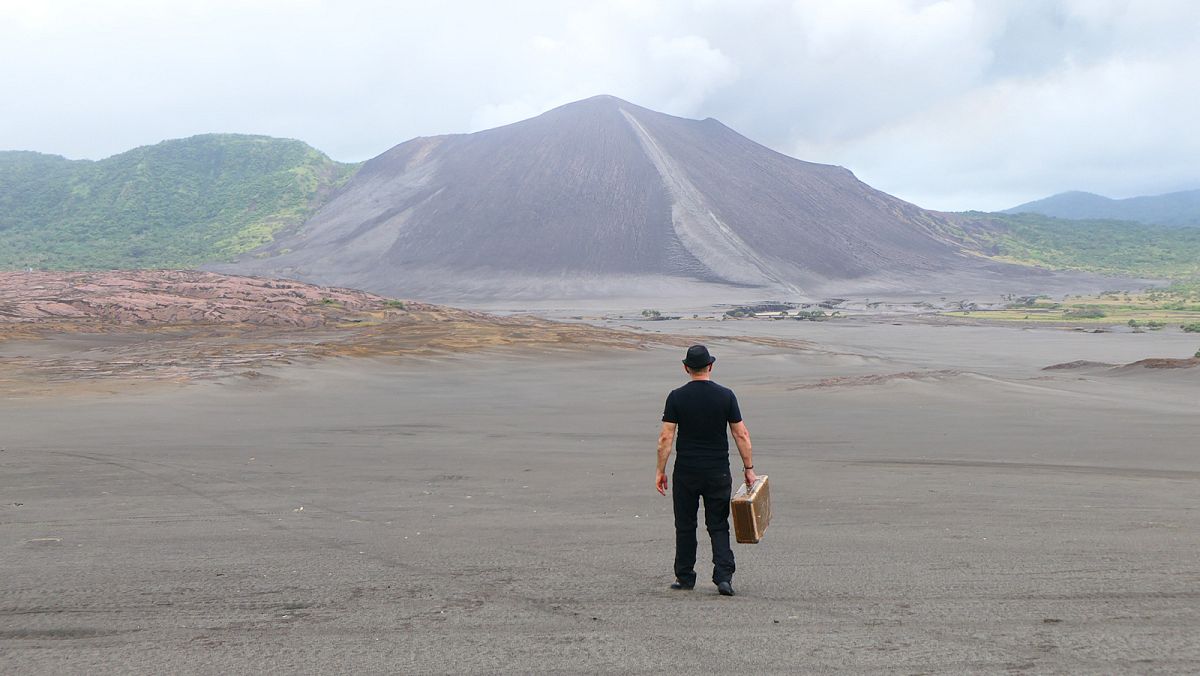


IMAGE GALLERY
(There are 9 images)